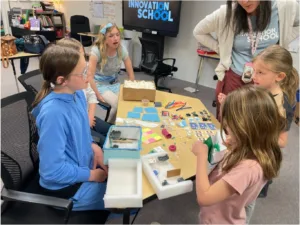
I absolutely loved my first year running my microschool, so continuing into the second year was a no-brainer for me. I felt like the students loved it as well as the parents, and of 13 students, 11 were returning. I had a growing list of interested families, which quickly snowballed into more than doubling my enrollment as soon as they were all awarded our state education savings account scholarship. It was exciting to grow and rewarding to feel like I was creating a real solution for families in my community. Growth felt like the obvious next step.
After weathering some growing pains for the last five months, and reflecting on the benefits and challenges that growth has brought, I am now sitting at a new crossroads. The growth of our school has made it basically impossible to insure the program in our home. We are faced with the dilemma of scaling back to our original size and model, or finding a new commercial space. Some spaces we have toured would allow for more growth; some would require it. I am discovering that the decision to grow is much more nuanced than simply whether to serve more people or make more money. While growth is one measure of success, I now realize that I am the gatekeeper of my learning community’s culture, the mission of my school, and the lifestyle I desire for myself and my family. Growth affects all of these things.
Our growth from year one to year two was exciting and carried less risk. We opened a second space almost as if we were opening an extra room in our own home. The second campus was a home we already owned, so we could set the rent ourselves, and we knew we could always return to placing a tenant there if needed. A commercial lease requires us to commit to a space for 3–5 years. This means committing to making not only the location work for us, but the size of the space and the financial burden. Where it was easy to take summer off from programming, we will now need to offer summer camps or after-school classes to cover the added rent. Growth stops being experimental when a lease enters the equation.
The growth question also highlights the fact that I currently wear both educator and administrator hats. As a small learning community, my administrative workload has been light enough that I can usually manage it on Mondays and then spend Tuesday to Thursday working with students—a role I really love. Evaluating models for the new space is pushing me to determine whether I will land in a “director” role, handling mostly administrative work, or try to hire that out in order to protect my time with students.
As part of my reflective process, I reached out to my current families. Whether or not we choose to grow into a new space, it was insightful to gain a clearer picture of the needs and values of the families we already serve. Ideally, our new space will be somewhere they all want to continue being, but I discovered that our current families are an intersection of three basic categories: unschoolers who want freedom and need childcare, homeschoolers who want social/collaborative learning opportunities, and school exiters who want an alternative option that still resembles traditional school in some key ways. Armed with this data, I will also return to my own list of goals for the school. It is evident that there is demand in my community for something that I am creating, but if I choose to grow, I want to be sure that I am not unintentionally redefining my mission.
I am also reflecting on what growth has already meant for our community, seeing this next stage with my eyes much more open. I had assumed that more peers would create easier social dynamics, and that larger groups would allow for more collaboration. Essentially, I had hoped that growth would make all of our systems work more easily. What I have discovered is that rapid enrollment shifted our culture, and that age distribution mattered more than total numbers. Our large increase in younger students in particular really amplified facilitation load, emotional labor, and staff capacity needs. I overlooked the transition time that would be needed to onboard not only new students, but also to help our original students adapt to larger groups. In some ways, growth felt like loss before it felt like progress.
However, after our first semester with a larger student body, I can say that while it took time to work some of it out, we have been able to see many benefits of a larger group. We have a dynamic group of ten 5–9-year-olds who play and learn together every day. I have found an awesome Montessori teacher who is excited to partner with me in growing this younger program. We have built a space at the second campus that is designed specifically for their interests and needs. Our older cohort has embarked on several projects and even begun to lead with their own ideas, requiring less and less facilitator help. In some ways, it fuels me to consider what is possible for them in a new, larger space. At the same time, I am learning that space decisions force founders like me to get clear about scale.
Being part of the growing microschool movement in a state that is facilitating school choice makes for an exciting journey. Demand can make a founder feel like she has no choice but to expand, but it’s important to understand that growth is not neutral. It has both costs and benefits. The goal isn’t necessarily to grow bigger, but to grow truer.