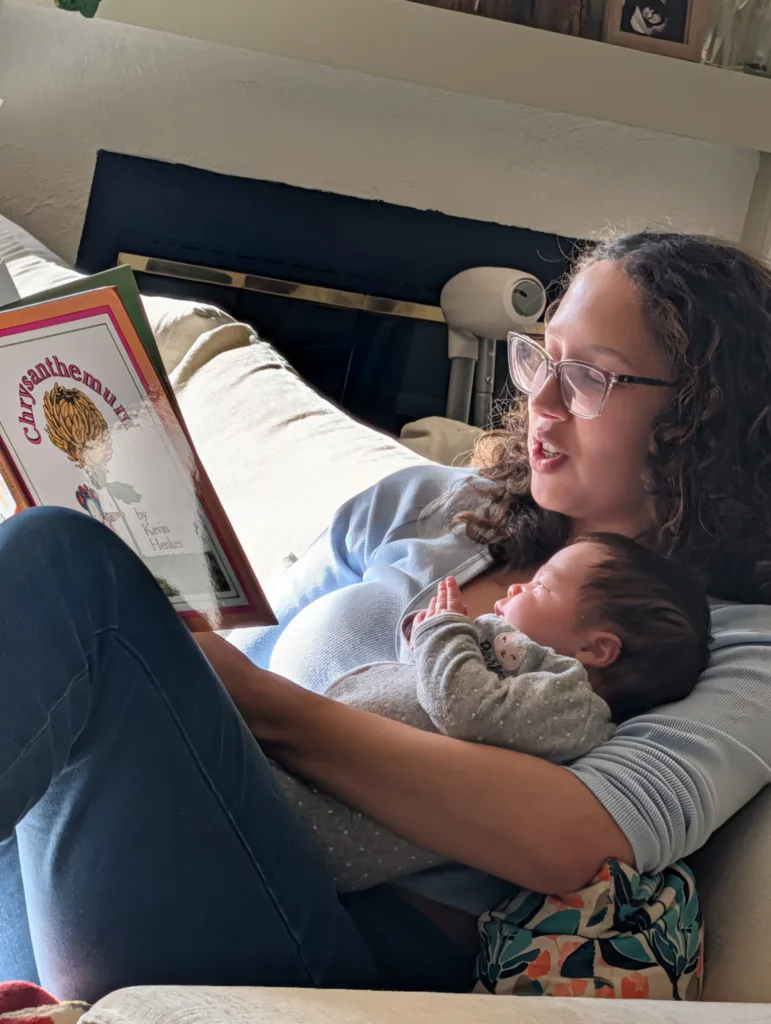
This year, I became a grandmother for the first time. It is the most magical experience, and one that I wish for every woman. Attending the birth of my granddaughter, holding her in my arms shortly afterwards, sharing that moment with my son-in-law and his mother, who also happens to be my best friend, there simply aren’t sufficient words to capture that moment. A month later, my daughter shared a picture of her reading the book Chrysanthemum to my grandbaby, and through that image, I saw the promise of the next generation of unconventional education.
Early on, both my daughter and her husband shared their intention to homeschool all of their children. What’s fascinating is that they arrived at that conclusion having two very different educational experiences. My daughter was fully homeschooled through high school with the assistance of in-person academic homeschool programs, called tutorials in Maryland. She ultimately graduated summa cum laude from college with a degree in Psychology that she now uses in her role as a preschool teacher, and regularly shares her experiences of having been successfully homeschooled through high school.
Educated in the public schools of Washington State, my son-in-law, Daniel, was the type of student who questioned everything, including and especially the relevance and usefulness of the amount of time spent in school, in addition to the manner in which he was being educated. His mother shared that although he is an extraordinarily intelligent person with an exceptionally high IQ, he would not do his homework, viewing it as useless busy work. Enduring seven hours of school attendance followed by five to six hours of homework was unbearable, and in response, he rebelled, and his grades reflected this. The struggles of children overwhelmed with long hours in school followed by near-crippling amounts of homework is not unusual and was the subject of a recent article in Upworthy.
Yet, even as he was drowning in the traditional academic setting, Daniel thrived as an athlete and as a Boy Scout. Gifted in speed and defensive strategy, Daniel was the co-captain of his community soccer team and led them as they won the league State Championship. Nicknamed “The Gazelle,” he was recruited to an elite soccer team, where he continued to distinguish himself as a standout defensive player. As a Boy Scout, he also thrived, earning his Eagle rank in the middle of his senior year.
In his mom’s words, “He was an extremely talented soccer player, but being in that school killed his spirit. In his senior year, he got mono, and it was only by the will of God that he graduated. He attended sporadically; there were fights to just get him to go to school.” Thankfully, she found one guidance counselor willing to work with him to produce the minimum amount of work to allow him to graduate high school. If his mom had to do it over again, she would have homeschooled him. “He would have been the perfect candidate for homeschooling. It was awful recognizing how intelligent he is, and knowing that his grades didn’t reflect this.”
Following graduation, Daniel took a gap year and spent four months in Costa Rica and Guatemala. “Three years of high school Spanish yielded nothing,” his mom recalled, “but he returned from Guatemala fluent in Spanish, with a beautiful accent and an equally beautiful understanding of the Latin-American culture and a desire to learn more about his own Puerto Rican heritage. That experience was life-changing for him.”
Real-life lessons from his time overseas and scouting translated into marketable soft skills of adaptability, high emotional intelligence, critical thinking, and problem-solving. These are among the skills identified by employers in a US Department of Labor publication as being “even more important to work readiness,” thereby offering a competitive edge for hiring. My son-in-law uses these skills daily as a successful property administrator in the Washington area.
While dating my daughter, Daniel learned more about the unconventional learning space and was fascinated by nature-based educational programs such as La Luz in Denver, Colorado, and Surf Skate Science in southern Florida. He also listened in on my online math study groups and commented that had he been afforded the opportunity to be educated in these types of spaces, he would have had an entirely different experience; he would have engaged in learning in ways he never did as a youth. Their very different educational experiences and exposure to the endless possibilities found within unconventional learning led them to decide to educate their own children outside of the traditional setting.
Their decision is also rooted in something deeper than personal experience alone. Homeschoolers and other unconventional educators have long known that children learn best when they are seen as individuals, not as data points. When curiosity drives the lesson, when children are celebrated in their uniqueness, when learning is connected to real life, incredible things happen. Children are not just given information to be regurgitated; instead, they develop a lifelong love of learning. My daughter has lived this, and Daniel experienced this transformation firsthand as a young adult.
My daughter has already asked me to establish an eXtend homeschool program in her area, one with instructors who are passionate about their subject area and love the children and families they serve. During my most recent trip to Washington, I met with the director and other leaders in the local Sammamish Chamber of Commerce. I shared our model of unconventional education and how we’ve succeeded with homeschooling through high school, and they are excited about the possibility of bringing similar unconventional learning spaces to their area.
Both my daughter and her husband, and the business leaders in Sammamish, want learning communities built with an understanding that every child is unique and has the right to be educated in a way that best meets his or her needs. Together, I see seeds planted for the next generation of unconventional learning.
From a new grandmother’s arms to a stack of picture books, from a soccer field and scouting experiences in Washington to the jungles of Guatemala and streets of Costa Rica, the seeds of unconventional learning are already taking root in the next generation. My granddaughter and her siblings who follow will never know a world where their curiosity is treated as an inconvenience or their individuality forced into a one-size-fits-all mold. The people who love them most have already chosen differently. Perhaps the greatest gift one generation can give to the next is the freedom to learn as they were made to learn, and communities bold enough to make that happen.