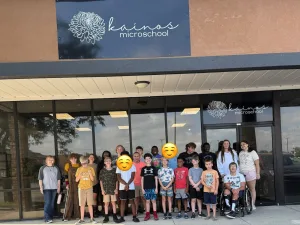
There’s a running joke in my family that if you spend any amount of time with us, you’ll find yourself involved in some type of service, whether it’s at a homeschool or community event, a church function, helping a neighbor, or simply pitching in around the house. Every young person who enters our family circle knows that at some point, they will be “voluntold” into some type of service activity.
I didn’t fully understand the significance of what I had been instilling in my children until a neighbor recently commended my son for being so helpful. For him, his actions were nothing extraordinary; he helped her move some items and then immediately cleaned up afterwards without being asked. She then made a very broad statement about how today’s youth don’t go out of their way to help others. When I responded that this hasn’t been my experience with my kids or those in our homeschool community, she shrugged and countered, “Well, Kym, you’re different. You teach your kids to serve. Nobody teaches kids to serve these days.”
While I would challenge the idea that nobody teaches kids to serve, it is noteworthy that an article from Track it Forward reports that 22 of 50 states have no volunteer requirements for high school graduation, but instead leave these decisions to local school districts, where standards vary widely. My home state of Maryland is one of the states that requires volunteer hours for graduation. However, from the beginning, our decision to create a culture of service in our homeschool community had nothing to do with the Maryland mandate, which applies to public school students. It came from a deeper conviction and a very practical need.
As parents and as leaders, we understand that volunteering benefits both the giver and the receiver. A 2022 US News & World Report article highlighted how volunteering helps teens, including developing career skills and exploring interests, building networks, and providing mentorship. However, when eXtend, the homeschool program I founded nearly a decade ago, began as an elementary and middle school program, those benefits were not on our radar. Instead, we had very real program needs, and at the same time, wanted to instill in our students the other skills and qualities that come from involvement in community service—leadership, compassion, a sense of community and purpose, teamwork, and problem-solving.
“Leave it better than you found it” is a family motto that was carried directly into our homeschool program. The same principle that prompts my children and me to return a neighbor’s borrowed truck with a full tank of gas, regardless of where the gas indicator was when we received it, is the same one that guides our homeschool community in caring for the building space we use. The adage “Many hands make light work” is ingrained in the fabric of our community, as even our youngest students are involved in classroom setup and cleanup. Combined with the spirit of intentionally caring for our neighbors, these three concepts form the foundation of eXtend’s culture of service.
Creating a culture of service is an excellent way to build community. If you’re looking for ways to incorporate volunteering into your learning program, here are some practical strategies that have worked for us at eXtend that you may find helpful.
- Parent Duty: From the very beginning of our program, we had very practical needs. On class days, we needed help with everything from setting up classrooms, to monitoring hallways, to monitoring snack time (which usually happened on a large field adjacent to our parking lot), to managing student check-in and check-out, to helping out in the classroom (especially on Science lab days), to cleaning the building and resetting rooms to the church’s requirements. We needed help. That help came in the form of Parent Duty, in which parents volunteer to be on-site for the entire day to assist with these tasks. The required number of volunteer days varies from year to year, typically between five and seven days during the year, depending on the number of families enrolled in our program, and the specific location needs. While Parent Duty is definitely work—our running joke is that if you haven’t broken a nail or broken a sweat, you haven’t done parent duty—it also strengthens our community. In the process, parents work together, forging relationships with one another, as well as with our instructors and leadership. Participating in the running of our program also gives families a profound awareness of and appreciation for our program, and provides an opportunity for parents to model the service we want to instill in our students. As an added benefit, if your program is a 501(c)(3), parent volunteer hours may translate into donation dollars from the parents’ employers if they participate in a charitable contribution program through larger giving platforms such as Benevity.
- Involving Students in Program Operations: At eXtend, we believe students can and should be equally involved in helping our program run, and when given the opportunity, they will step up. Very early on, students learn how to set up their classroom, and oftentimes, the students actually teach and lead the adult volunteers in setting up and breaking down classrooms. I’ve watched 6th, 7th, and 8th grade students direct parents to grab room supply bins and dry-erase boards, while the students handle setting up tables and chairs. In the afternoons, our youngest students help wipe down dry-erase boards and tables, and empty out trash from their rooms. Students also assist with community events, such as our Promotion and Graduation ceremonies, homeschool fairs, and used curriculum fairs, by setting up tables and decorations, serving as ushers, and even running concession stands. As students participate and volunteer, they take pride in and ownership of their learning spaces, they develop as leaders, and learn to work together to help our program and community events run smoothly. Additionally, we award volunteer hours to our students whenever they assist, and it is not unusual for some students to graduate having amassed several hundred hours of community service.
- Field Trips That Double as Community Service: A few years ago, one of our parents introduced us to First Fruits Farm, a farm with a mission to address food insecurity by growing and harvesting food that they distribute to local food banks. It has become a staple for our community and the greater homeschool community. Our community also recently added Aswanna Farm as a volunteer opportunity for our students. Socially-minded field trips such as these not only teach our students about sustainable farming, health, and the environment; they also cultivate compassion and empathy in our students as they serve others in need.
- Encourage Student-Led Service Projects: A few years ago, one of our high school students asked if he could collect new and gently used books during the spring semester to donate to needy families. Our response was an enthusiastic YES! He created collection bins, and as a community, we collected hundreds of books, as most homeschoolers are known for having massive book collections from years of curriculum. Another year, a student asked to collect socks around the holidays that were donated to a local shelter. Still another year, we collected coats and blankets to distribute to needy families. This year, our senior class created “meals in a bag”—Ziploc bags that included non-perishable ingredients for a full meal—that were taken to a local food bank. We have found that some of our most successful service projects were those that were initiated by our students.
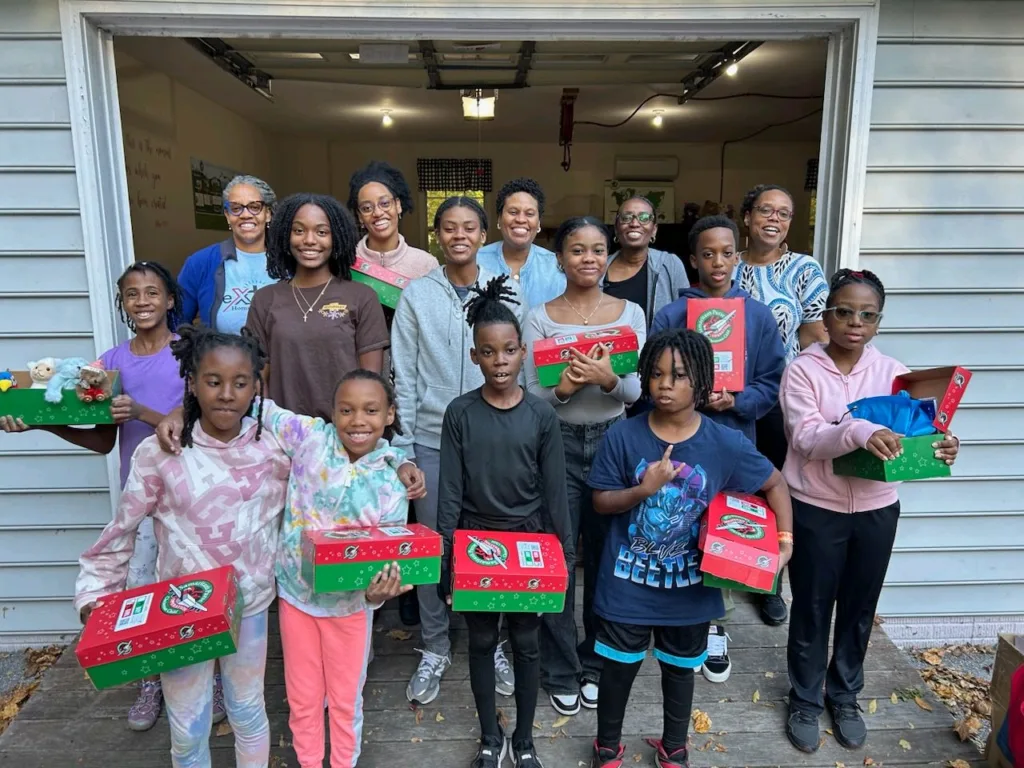
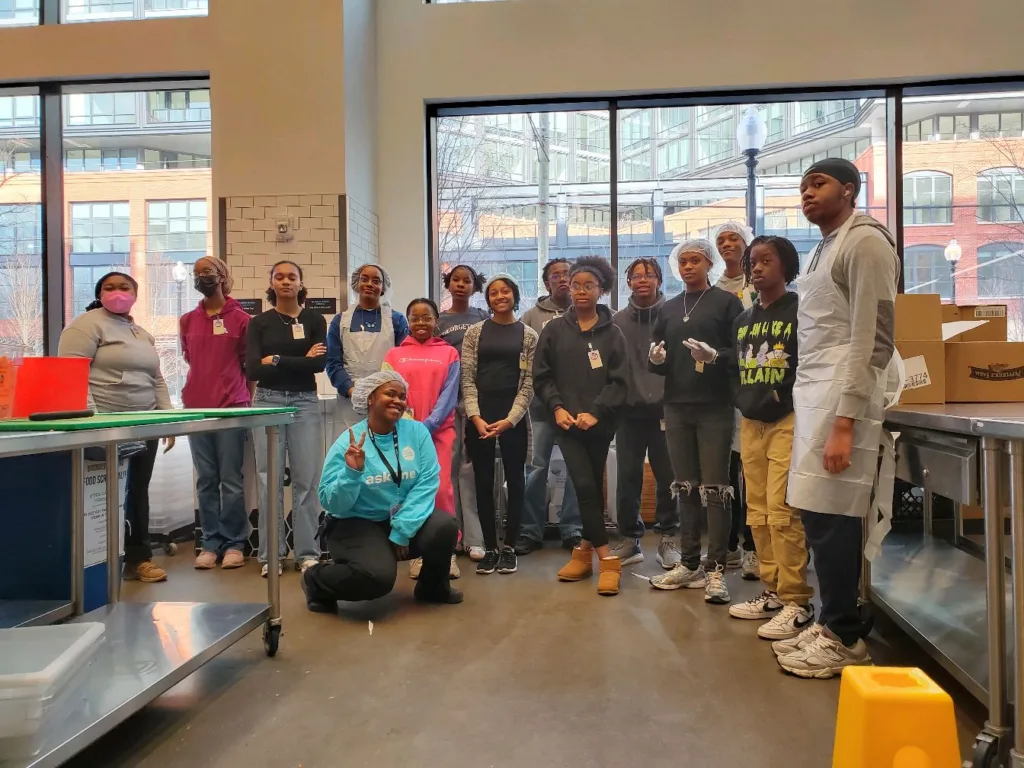
- Host a Service Organization: Last year, several parents from our program launched the eXtend chapter of the National BETA Club, a leadership and service organization for students in elementary, middle, and high school. Ours is the first and only homeschool BETA Club chapter in the state of Maryland. BETA members meet monthly for service projects, which have included assisting at DC Central Kitchen and Martha’s Table, volunteering at a senior facility, packing Christmas boxes for needy children, and sorting and packing food for a local animal shelter. Hosting national service organizations is a powerful way to elevate student service opportunities within your program, and can be a great addition to students’ transcripts.
We have experienced firsthand the benefits of incorporating volunteering into our program and its transformative effects on our students. They understand the importance of helping others, and we have heard from parents how their students’ service in our community has spilled over into serving more at home. Volunteering truly benefits everyone involved. As leaders in the unconventional learning space, we have a unique opportunity to shape not only academically strong students, but compassionate, community-minded leaders. By intentionally teaching children to serve, we strengthen both our learning programs and our broader communities.