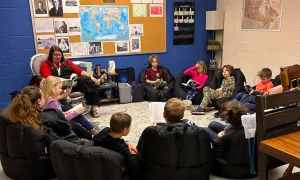
I’ve shared before how two pieces of legislation, passed almost in tandem, prompted my decision to launch my microschool. This was a dream I had envisioned for about four years, but felt really unsure about how to get started. Being a homeschooler, it felt natural (and less risky) to start it in my own home, so I was especially relieved when Utah passed a zoning law to define microschools in a way that allowed them to operate legally in residential homes with up to 16 kids. We opened our home up to several families, totaling 8 kids in our first year, and enjoyed creating a dynamic learning community with them.
What I didn’t anticipate was that zoning would turn out to be the easy part.
I have learned this year that just because the law permits it doesn’t mean that insurance companies are willing to insure it. I have now worked with four insurance brokers, and spent countless hours trying to get coverage for our school, now operating out of two homes, providing seats to about 30 students. With the rapid expansion of the school, my focus was on our two learning spaces, onboarding new families, hiring new facilitators, training them, setting up payroll—a myriad of things I hadn’t experienced in our first year. Insurance was somewhere on my list, but because that had only required a quick email to our agent the first year, I wrongly assumed that we would just need a second policy for the second campus, just like the first. I now know that that is not how insurance works.
Instead, our agent congratulated us on the growth of our school, and then informed us that we would likely lose our homeowners insurance if we kept such a large school in our homes. He then encouraged us to find another agent as our needs were now out of his wheelhouse.
The National Microschooling Center seemed an answer to my prayers when they hosted a webinar specifically on insuring microschools. I learned that microschools present several challenges to insurance companies:
- They are small. Often, policy rates are “per student.” Essentially, a large school or even better, a whole school district, can pay large premiums which justify the cost of the potential large claims. In a small school, the company is taking on the same risks (working with children, foot traffic in and out of the building, field trips/travel, etc.) but only taking in a small premium.
- There is very little data (especially for home-based models) to help assess risk. Because we are a new section of the market, it is difficult for underwriters to assess risk, so by default, they assess high. This can mean either really high premiums or simply refusing to insure you altogether.
- In addition to the challenge of assessing risk, being a new and small section of the market means that there are very few, if any, of what I call pre-packaged options. With so many varied models, there aren’t concrete buckets to put us in. Some use “tutoring center”; others, “specialty school” or “learning center.” This essentially translates into filling out long application forms that feel quite daunting to a new business owner like me.
- Home-based models are messy for your homeowners policy. Insurance companies want to know who is responsible for what, and when you run a business in your home, it is hard to decipher what counts as a business claim and what was due to personal use.
Preschools have been operating out of homes for decades. When I first started my search, I felt hopeful knowing that in many states, homeowners policies allow in-home preschools simply as an additional coverage. I assumed that if our state was explicitly encouraging microschools, the insurance industry would surely adapt alongside it.
Instead, I found the opposite trend. Where policies once allowed 8 children in these types of preschools, many now cap at 5. For some reason, insurance companies are getting more cautious with home-based businesses serving children. I did find an agent willing to look into it for me, but while he found some creative solutions, the premiums were going to be at a premium cost. As that agent described it to me, you essentially have to choose between insuring your business or insuring your house. That didn’t feel like a choice I could make.
Finally, just before Thanksgiving, three months into our school year, he found us a set of policies and extra coverages that seemed to cover almost everything. The price was high, but compared to a commercial lease, it was still the better deal. We decided to sign, only to find out at the last minute that they had somehow missed our statement saying that we offer woodshop. Woodshop was out of their scope. The deal was off.
Some might find it crazy that we didn’t just choose to drop woodshop, and believe me, we wrestled with the decision. But the thing is, our hunt for insurance was uncovering a more important set of questions for us. What is this business? Is it a side gig? Is it a co-op to get our own kids through homeschool? Is it a legacy? How long do we foresee ourselves running this? Can it provide a retirement for us? How many kids do we really want to serve in our community?
Sure, staying in our home feels safe. It was a great way to springboard our idea and test its feasibility. And we have actually loved hosting the school in our home. But staying in our home is also going to continue to limit the scope of our business. We will always (or at least for the foreseeable future) be limited on the number of insurance companies that are willing to work with us, making it difficult to have any kind of competitive pricing. And when that company decides that they don’t cover this or that anymore, we might be left high and dry.
So we started our search for a commercial space that would be easier to insure. And ironically, the minute we started envisioning the school in a new space, I almost couldn’t picture it in my house anymore. I began seeing all the benefits of a dedicated space for the school, and some rest for our now well-used home. Our agent commented once, feeling badly that he couldn’t find more options for us, that he felt it was crazy we were needing to make business decisions based solely on insurance, and I agreed at the time.
But while I do hope that more insurance options will open up to make home-based microschools an even more viable option, I am choosing to see this roadblock in my own journey as the entry point to a path we may not have considered, but that has a destination we will like better.