When learning is connected and meaningful, retention deepens and understanding grows
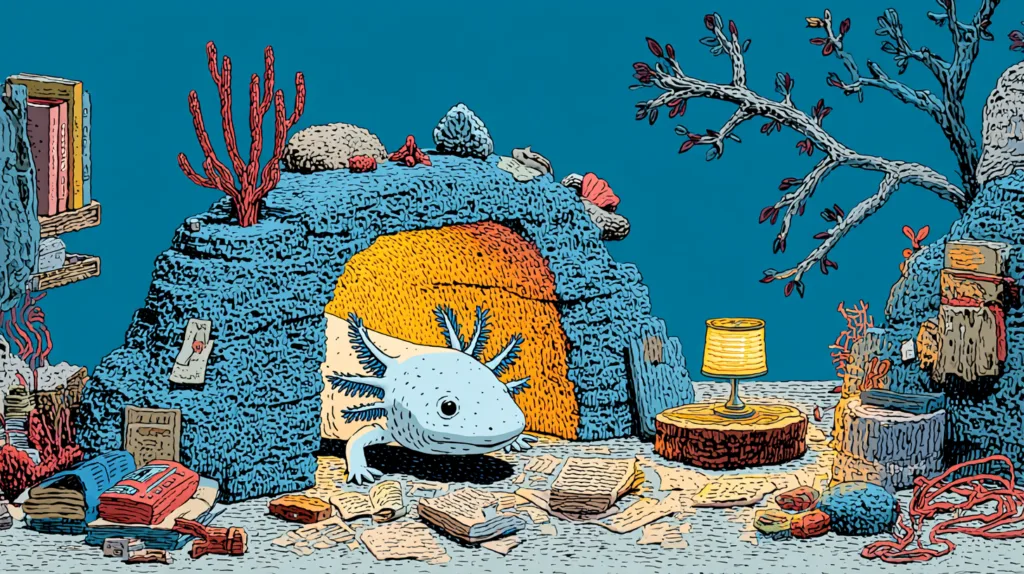
Recently, our school’s younger class was given miniature axolotl figurines. If you aren’t familiar, axolotls are cute salamanders that are all the rave right now. What began as a simple, fun surprise quickly turned into something much more.
Students started by designing homes for their axolotls. They started thinking about habitat, environment, and what their creatures might need to live. Then the ideas grew. Those tiny figurines became characters. Each student began creating a story about who their axolotl was, where it came from, and what adventures it might have. Soon, those individual ideas expanded even further as students began building entire communities. They started connecting their axolotls’ worlds, creating shared spaces, relationships, and systems within them. Our teacher didn’t hand them a worksheet or assign a prompt. Instead, she stepped in as a guide to help shape their ideas into stories, naturally weaving in lessons on story elements, spelling, and grammar along the way. What could have been a quick activity became a rich, integrated learning experience driven naturally and entirely by curiosity.
And it started with a small plastic axolotl.
Before we can improve school, we have to ask a deeper question: What is school actually for? For us at The Innovation School, that question didn’t lead to a packaged curriculum or a scripted program. It led us to a philosophy that has shaped how we see children, learning, and the role of a teacher. That philosophy is the Reggio Emilia approach. It began after World War II in a small town in Italy, when a community led by educator Loris Malaguzzi set out to reimagine what education could be. After the destruction of the war, they wanted a system that wasn’t built on compliance or rigidity. They wanted one built on curiosity, real-life experiences, and human potential. The belief is that children are already full of ideas, questions, and theories about the world. It means that we don’t simplify learning; we trust that our students are capable, and we listen just as much as we teach.
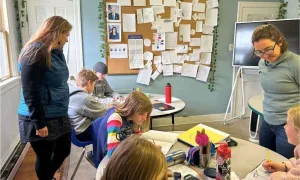
It also shifts the role of the teacher. Instead of being the “sage on the stage” delivering information, the teacher becomes a guide who observes, asks questions, and provides materials and structure when needed. The classroom itself becomes part of the learning. In Reggio Emilia, it’s often called the “third teacher.” Spaces are intentionally designed to invite curiosity, materials are accessible, and learning is actually visible. You’ll see projects in progress, collaboration happening naturally, and thinking documented everywhere. Learning isn’t something that happens to students; rather, it’s something they actively build.
Learning often begins with student interest instead of a fixed curriculum. We call this inquiry. A question during play can turn into a full inquiry. A small idea can grow into weeks of exploration. Students take on the role of researchers, designers, and problem-solvers. This is what happens when learning is allowed to grow instead of being rushed. Learning in this model is deeply social. Students aren’t just absorbing content; they’re also learning how to work through disagreements, listen to different perspectives, and build ideas together. In a mixed-age environment like ours, this happens even more naturally. Older students lead, and younger students observe and contribute. At the same time, learning is made visible through documentation. Teachers capture progress through photos, videos, and written reflections so that students and families can see what they are working on, and also to help students revisit and deepen their thinking. It sends a clear message: your thinking matters, and your learning is your own.
Another core idea from Loris Malaguzzi is the “hundred languages of children.” This is the belief that students express understanding in many different ways. This isn’t just through writing or tests, but through art, movement, building, storytelling, and discussion. Not every child shows what they know on a worksheet, and not every child thrives in silence and stillness. When we expand how students can show understanding, we expand who gets to feel successful in school.
Of course, this approach isn’t without its critics. Some argue that without a fixed curriculum, students will have gaps in their learning. Others worry that it lacks structure, or that it depends too heavily on student interest. There’s also a concern that this kind of environment doesn’t prepare students for the “real world,” where expectations, deadlines, and standards exist. These are fair concerns. But what we’ve found is that structure and flexibility are not opposites. They can, and should, exist together. Our students are still learning standards. They are still building foundational skills in math, reading, and writing. The difference is how they get there. Skills are taught in context, not isolation. One example of this in action is our students writing reviews of local food. They’ve been trying different bites and drinks from local restaurants and writing honest, yet respectful, reviews. Along the way, they’re learning how to form opinions, support those opinions with reasons, and communicate clearly to an audience. What looks like a fun activity is actually rich literacy work where they are practicing writing structure, grammar, vocabulary, tone, and purpose in a way that feels real and meaningful. When learning is connected and meaningful, retention deepens and understanding grows.
As for the idea that students need constant external direction to succeed, we would argue the opposite. The real world doesn’t hand you a worksheet and tell you exactly what to do next. It requires problem-solving, adaptability, collaboration, and initiative. These are the very skills this kind of environment develops. And while it may look less controlled from the outside, there is a great deal of intentionality behind it. Teachers are constantly observing, adjusting, guiding, and ensuring that students are progressing. It’s not a lack of structure. It’s a different kind of structure that is responsive rather than rigid.
Being inspired by the Reggio Emilia approach gives us a foundation we continually return to. It provides a way to ground our decisions and reflect on our practices. Not everything we do follows the approach exactly, but it offers a clear path forward. It reminds us to see children as capable, to let curiosity lead, and to design learning that is active, social, and meaningful.
And sometimes, it starts with something as small as an axolotl.