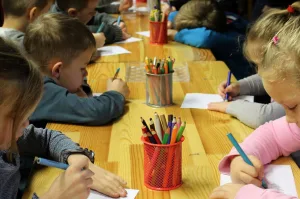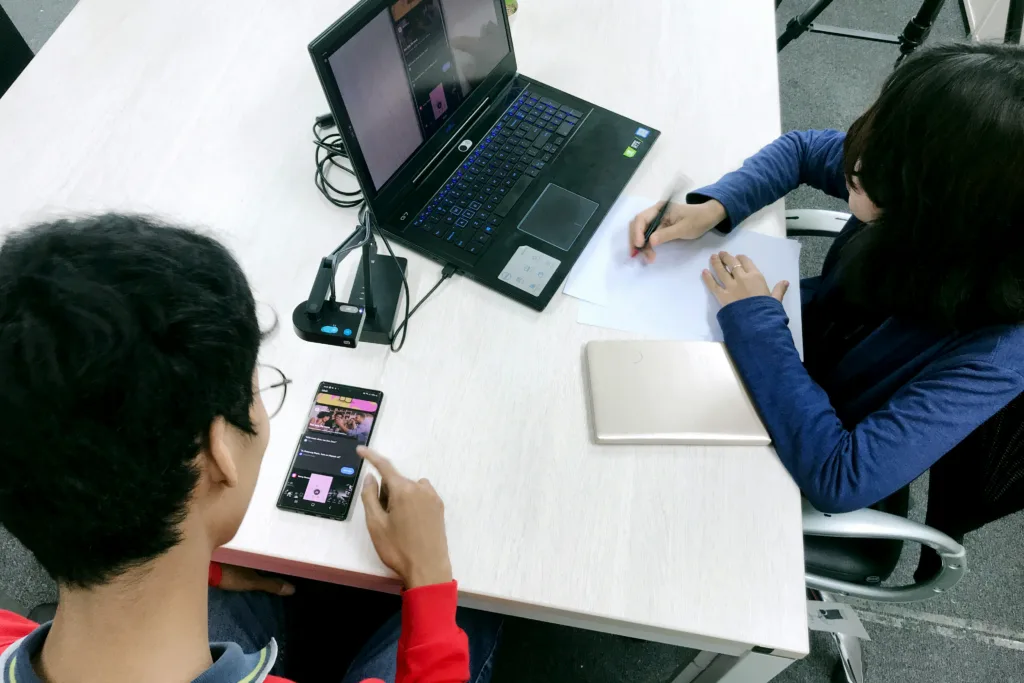
On a normal day at The Treehouse Agile Learning Community, I take lots of photos. I capture moments of play, exploration, project work, and finished projects ranging from Lego inventions and handsewn costumes, to rock art and fairy gardens. On one such day, I was capturing a moment where one of our 7-year-olds was playing sidewalk chalk games with one of our facilitators. He looked at me and asked, “Why are you always taking pictures of us?” It caught my attention because we were three months into the school year, and I realized that I had never explained our documentation process to our youngest students. It got me thinking: I know what and why I’m documenting, and I know the parents value the photos, but I didn’t actually know what the kids thought the photos were for.
I began to wonder: Are my students experiencing documentation as celebration, or as surveillance?
I came upon self-directed learning via homeschooling. I fell in love with the flexibility of homeschooling so much that I started leaning entirely into my kids’ interests. I found it invigorating to let go of other people’s timelines and subject categories, schedules, and benchmarks, and start making rhythms and setting goals based on our family’s needs and values. My passion for “unschooling” (as I came to learn that was what I was doing) led me to start my own center for self-directed learning. I believed deeply in cultivating space for kids to be curious, follow intrinsic motivation, learn from their interests, and develop the skills of self-reflection in place of constant external evaluation.
In our first year running our microschool, I was blessed to partner up with several families who believed in this vision as well. They were happy to see their kids thriving as we put less pressure on academics, and gave them space to grow emotionally, socially, and physically and to develop a variety of skills through passion projects and experiences. We took lots of photos to commemorate our events and projects, but I was running things more like a homeschool co-op at that time. I would send parents photos here and there that I thought they would enjoy, but we didn’t have any official record-keeping or documentation. The smiles on the kids’ faces and their desire not to have school end were our measures of success.
Things shifted in our second year because we more than doubled our enrollment, and most of our families were paying their tuition using taxpayer-funded education savings account (ESA) scholarships. In order to qualify for families to use ESAs, we had to get our program approved as the primary source of our students’ academic instruction. I still believed strongly in the value of kids doing project-based learning, of integrating academic subjects and applying academic skills in real-world ways, following their interests. My families believed in this, too, and had come to me for that very experience. But the new regulations governing the ESA funding left me feeling more pressure to justify and quantify the learning of our students in a more formalized way. I needed a solution that would help me easily document all the amazing self-directed learning I saw happening every day, and translate it into measurable academic growth. I did not want it to increase my workload too greatly, and more importantly, I did not want it to turn learning into something that is constantly judged.
After three months of what I thought was “subtle documentation,” this 7-year-old made me realize it hadn’t been so subtle. His question made me ask myself: Why am I taking all these photos all the time? And what is the experience of the children being photographed? What is their experience when they go home? Do these photos serve for parental evaluation? Are kids wondering if they are curious about the “right” things? Choosing the “right” ways to spend their time here? Doing “enough” projects? The Hawthorne effect (sometimes referred to as the observer effect) states that individuals modify an aspect of their behavior in response to their awareness of being observed. I wondered: Is it possible to create a space where kids feel genuinely free to explore, and still document all the growth happening behind the scenes? Does it matter if kids feel observed?
The solution I found for documentation is called Prism, and I took my question to its creator, Tomis Parker, who also created the Agile Learning Center (ALC) network, of which my microschool is a part. His reframe of the documentation process reminded me of all the things I love about unschooling. Growth is a relational experience. That means that relationships matter whether they are between kids and what they are exploring or learning, between kids and educators, kids and their parents, and even kids and the documentation process. And we, as their guiding adults, shape those relationships. Tomis presented the idea of celebration culture to me.
In traditional documentation frameworks, we ask:
- Did they complete the assignment correctly?
- Can they prove they know the material on a test?
It is focused on assessing the students by comparing them to standards.
In a self-directed learning environment, we want to ask:
- What are they exploring, and how can I help them take it deeper?
- What are they building, and what new tool might I introduce to help them go farther?
- What are they discovering, and what related interests might I introduce?
Thus, the role of documentation in my learning environment should serve three purposes first and foremost:
- Celebrate with the students.
- Help me be a better guide by helping me be curious about the students, see patterns, and respond to their interests.
- Quietly build a portfolio of the students’ growth and interests over time to help them with their chosen future endeavors.
Documentation and reporting aren’t going away for me, and honestly, this mindset shift has helped me see it as a healthy tool for growth. My goal is to help kids use documentation to build the skills of self-reflection. Documentation at The Treehouse is for noticing, sharing excitement, telling the story of learning, and ultimately, helping kids own their narratives.