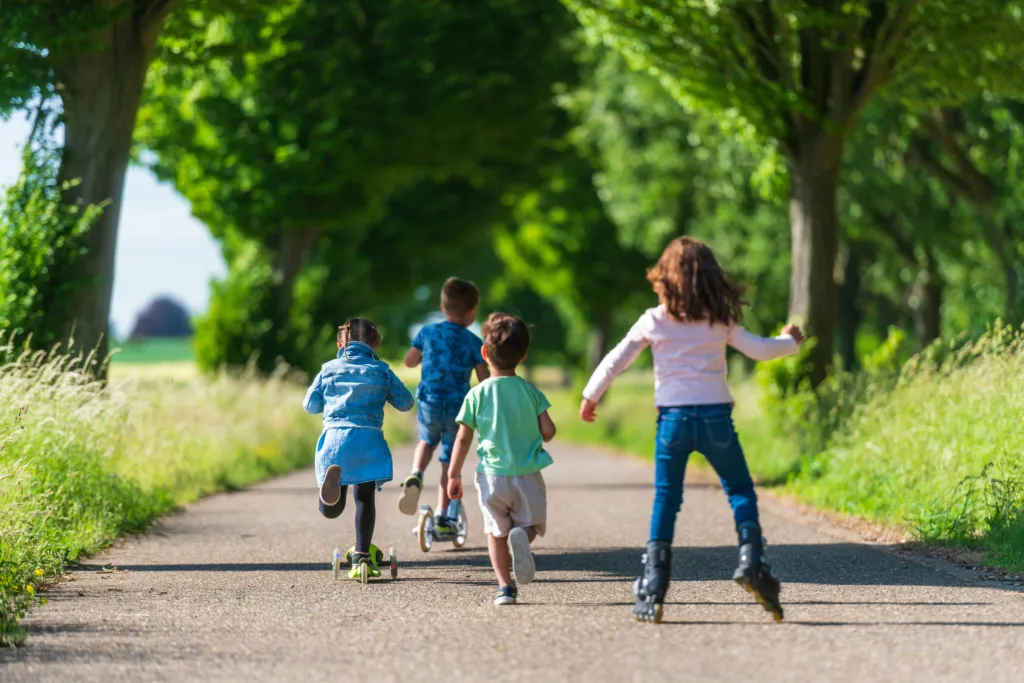
One of the most common questions we get during tours of our learning space is this: “With such small class sizes, do you worry about socialization?” It’s a fair question, and something I also worried about with my own children. I stayed home part-time, and otherwise they were with dad or their grandmas. As a new mom, the message I heard about staying home with my kids was that social development comes from being surrounded by lots of peers. Initially, I was worried about what my choice would mean for my kids, but something deep inside me knew differently. Once it was time for my daughter to go to kindergarten, the thought popped up again. Here, I was about to put her in another situation where she was around only a small group of people. Once again, I trusted my gut. As I’ve observed her and the other students over the years, it got me asking a question: Have we confused being around people with actually learning how to be with people?
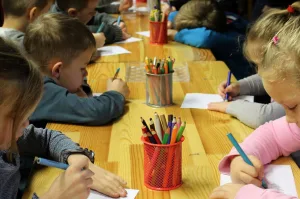
In most traditional settings, socialization is defined by numbers. The typical picture is thirty learners in a classroom who are the same age and have the same schedule. They have limited time to talk, and even less time to get to know one another and work through conflict. We assume that proximity equals connection. But if we’re honest, a lot of what happens in those environments isn’t deep social learning. It’s surface-level interaction where students navigate noise, manage peer pressure, and figure out where they fit in a crowd. That’s not nothing, but it’s also not everything.
Real social growth happens in moments that are harder to measure, such as working through a disagreement, learning how to include someone who is different from you, adjusting your communication depending on who you’re talking to, taking responsibility when you’ve hurt someone, and learning how to develop healthy boundaries. Those life skills don’t come from being around countless peers. Instead, they come from experience, reflection, guidance, and time.
In a smaller, mixed-age environment, something different happens. There’s nowhere to hide, but also nowhere to get lost. One of my favorite things about my daughter’s experience is that she is truly and deeply understood on a personal level. When learners get to interact with older peers who model maturity, and younger peers who require patience and leadership, it starts to look less like a classroom and more like a community. In many ways, it mirrors how kids used to grow up on farms, in large families, and in communities where learning how to relate to others wasn’t only by age or confined to a single room.
Smaller groups don’t eliminate conflict, but they provide a good enough “dose” of it for healthy learning. When the group is small, you can’t just avoid someone and move on to a different friend group. You have to work through it. And when that process is supported by adults who stop and value those moments, that’s where real social skills are built.
So, I no longer worry about socialization. We think about it differently. It’s not about how many people children are around in a day, but about how deeply they engage with the people they are around. The goal isn’t to raise kids who can survive in a crowd, but rather to raise kids who can build meaningful relationships, communicate with empathy, handle conflict, and show up as members of a community—all skills that are developed through intentional human experiences.