My youngest son, Samuel, began 2025 by deciding to go all in and pursue his childhood dream of becoming a commercial airline pilot. He was in his senior year of high school taking an Aviation Science course in our homeschool tutorial, and as our Christmas break was coming to an end, his college application journey was beginning, albeit what some would consider “late” in the season. Much of that journey was chronicled in a LiberatED Podcast series with Kerry McDonald. As 2026 is beginning, and as we have reached the end of his first semester in college, I have witnessed firsthand the payoff of an unconventional education.
Homeschoolers and those choosing the route of unconventional learning will tell you that students educated outside of the traditional setting do indeed thrive, and there’s enough data coming out to support this. Data from the nonprofit ACT.org show that homeschoolers have consistently outperformed their public school peers on the ACT college entrance exam since at least 2001. Anecdotes abound of the resiliency, ingenuity, perseverance, creativity, and emotional and academic excellence of unconventional learners, and I’ve witnessed all of these qualities in my son this year.
Samuel approached the college application process with intentionality that was developed during his homeschooling journey. He chose his list of schools by visiting every major airline’s website to identify the universities with which they were affiliated and from where they drew their pilots. As he went through the college application process, there were inevitable bumps in the road that he navigated with follow-up calls and emails to admissions offices that, in one instance, turned a rejection into an admission. A document that was submitted late by our umbrella-school director led to the rejection; however, after multiple calls and emails requesting a reconsideration, he was admitted. That particular university was one we visited on our 10-day whirlwind college road trip that was documented on Instagram.
Concurrent with the admissions process was the maze of completing the FAFSA financial aid form and scholarships. Samuel earned his family title of “Scholarship King” in 2025 as he sought out and applied for every available scholarship he could find, and also applied for admissions into honors programs, which typically have accompanying institutional scholarships. So extensive and zealous was Samuel’s scholarship search that in October, he received an award notification for a scholarship he had long since forgotten about!
Throughout the college admissions, financial aid, and scholarship application processes, Samuel, who considers himself shy, was pulled outside of his comfort zone as he interacted with admissions counselors, financial aid officers, and even staff at FAFSA and the Maryland Higher Education Commission. There were countless emails and phone calls exchanged with all of these entities, and a number of schools bent over backwards to assist him, moved, I am sure, by his perseverance. What I witnessed was a steady development of confidence, self-advocacy, and tenacity. These were skills fully taught not through textbooks, but through learning outside of the box.
Samuel was accepted into, and offered merit scholarships at, all but one of the sixteen schools he applied to, including Embry–Riddle University, Jacksonville University, The Ohio State University, and Kent State University. Ultimately, Samuel chose to attend the University of Maryland, Eastern Shore (UMES), where he is an Aviation Science student with a Professional Pilot concentration, and is also enrolled in their Honors Program. The earlier communication and persistent follow-up skills that were honed during the college and scholarship application process were further refined as Samuel navigated UMES’s campus programs and administration.
At the beginning of August, Samuel participated in the FLAGSHIP program, a two-week residential orientation designed to familiarize students with the honors structure, to provide opportunities for them to connect meaningfully with their instructors and fellow honors classmates, and to get a jump start on the required Honors 101 course. Although he initially lamented the early loss of his summer, through FLAGSHIP, he found his core college friend group and formed relationships that would later prove crucial as he worked with school administrators and department staff, creating and securing his schedule.
Since he had dual-enrolled at the local community college while in high school, Samuel worked with his academic advisors to ensure that his previously earned college credits were properly transferred and applied. As a result, he earned credit for all of his first-year college English classes, needing only to take a speech class to finish off his degree requirements. For math, he earned all of the credits he needs for his degree and will take a finance class because he wants to, not because he needs to.
So fervent and successful was Samuel’s pursuit of scholarships that the school initially planned to reduce his institutional awards. However, Samuel is an aviation major, and mandatory flight instruction, along with the various required ratings, is a significant additional expense that we simply don’t have the funds to cover. His is one of the most costly degrees, not just on the UMES campus, but nationwide. Samuel worked closely with the aviation department to have his financial awards structured so that they cover everything, including these necessary flight costs. Thanks to his diligence and persistence, Samuel is attending UMES tuition-free.
As Samuel thrived in an unconventional learning space as a homeschooler, he is now blossoming on a conventional campus as a first-year college student in an Honors Program and in one of the most academically challenging fields. Shortly after midterms, Samuel called me to share that while the median score on the midterm exam in his aviation fundamentals class was a 62, he earned a 96. Earlier, in an article about how homeschooling can provide an answer to the UCSD Math Preparation problem, I shared that Samuel was tutoring his fellow freshmen in math. My son is flourishing academically, and in his own words, is “locked in.”
Samuel is also succeeding socially, having an established friend group from his participation in the summer honors program. While it is well understood and accepted that college freshmen “party,” Samuel has once again taken an unconventional route. In his car (needed on campus because aviation students must provide their own transportation to the airfield), he carries a fishing pole, and he regularly sends videos and pictures of his latest catch. Fishing is his source of relaxation and stress relief. He has also stated that his goal of becoming a commercial airline pilot and the need to be FAA medically fit are reasons enough for him to stay out of the party scene. I couldn’t be more proud.
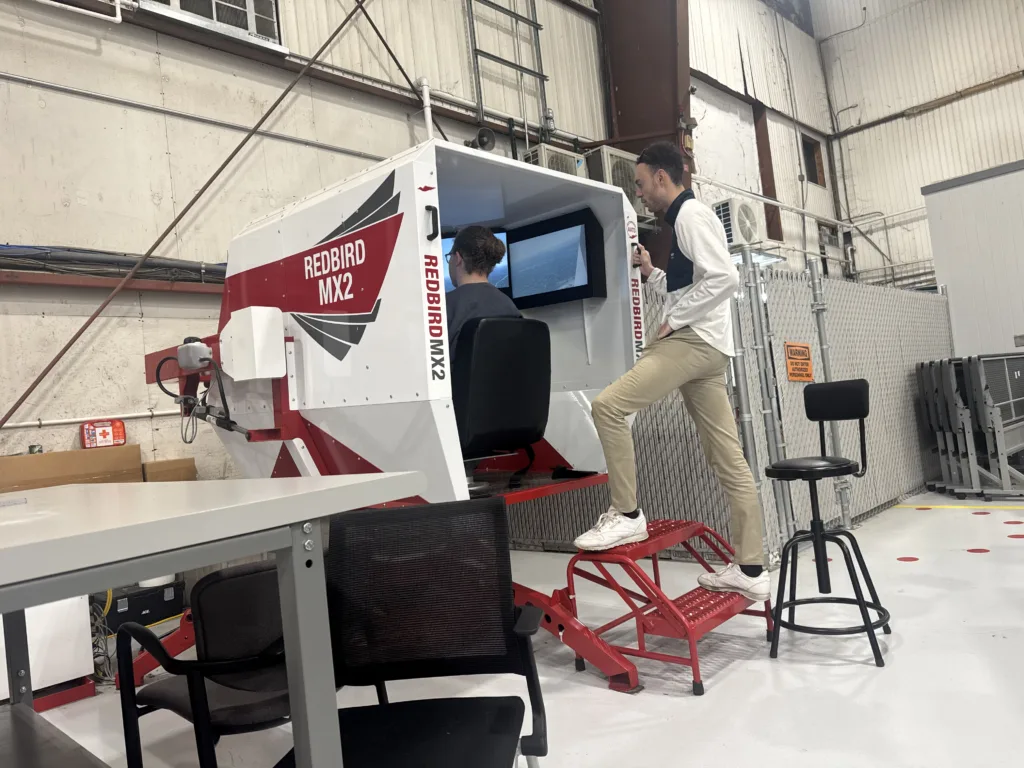
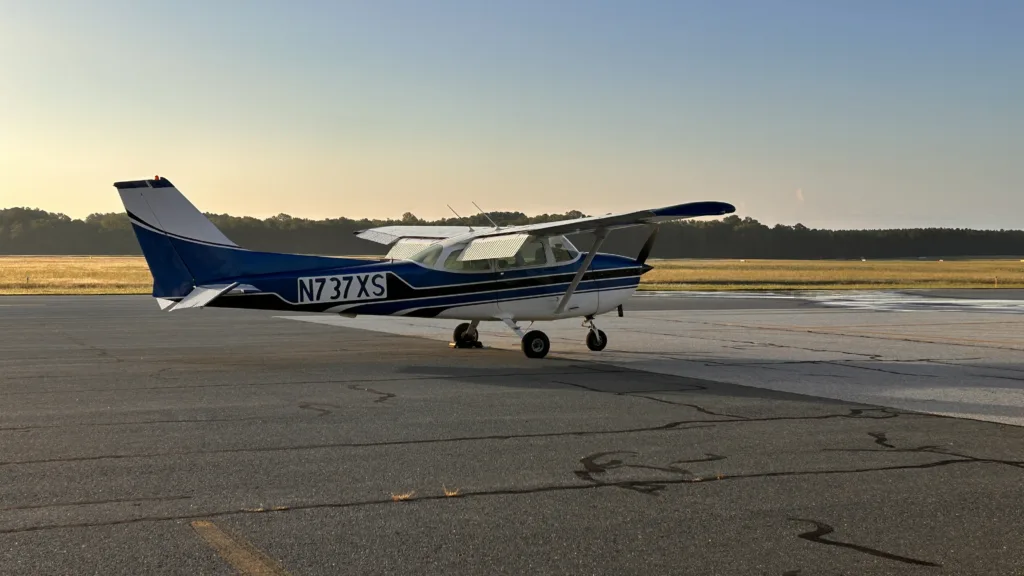
While others would mentally shut down on Christmas break, Samuel worked out an arrangement with his former Aviation Science instructor, wherein he is creating quizzes for her ground school class using all of the FAA private pilot written exam (PAR) questions in exchange for flight simulator time. The airport where she instructs is an hour from our home, but for Samuel, the sacrifice of time and effort during his break is completely worth it. His goal is to obtain additional flight hours through an FAA-approved simulator as he works towards his private pilot license, which is a necessary benchmark for becoming a commercial airline pilot, and an integral part of his aviation degree program.
Just prior to Thanksgiving, my son called me from school, and more than just filling my heart, his words were a confirmation and a payoff for the years spent homeschooling. “Mom, few people are able to say that they are living their dreams. That’s exactly what I am experiencing here in college. I am at a school studying to become a pilot. I am flying every week, and I see my dream happening.” The next three words that proceeded from his lips are words of life for every parent, regardless of the educational setting they have chosen: “Thank you, Mom.”
For those naysayers who believe the myth that homeschoolers and unconventional learners cannot go on to colleges of their dreams; who believe the myth that scholarships are unattainable for unconventional learners; who believe the myth that unconventional learners cannot thrive when placed on a college campus; who believe the myth that unconventional learners are “unsocialized” and cannot navigate adult conversations and adult situations; who believe the myth that there’s no adequate payoff to the time and energy expended in unconventional learning, I present my son. And the reality is that my son is one of countless homeschoolers and unconventional learners around the country who are blowing those myths out of the water every single day. Unconventional learning works, and the payoffs are real.