The German word Kindergarten literally means “children’s garden,” and that alone tells us something about what it was originally supposed to be. When German educator Friedrich Froebel developed the idea of kindergarten in the 1800s, he did not envision a room full of five-year-olds completing worksheets, preparing for assessments, or racing through academic standards. He imagined a place where children would be nurtured, given room to grow, and surrounded by experiences that allowed their natural curiosity to develop.
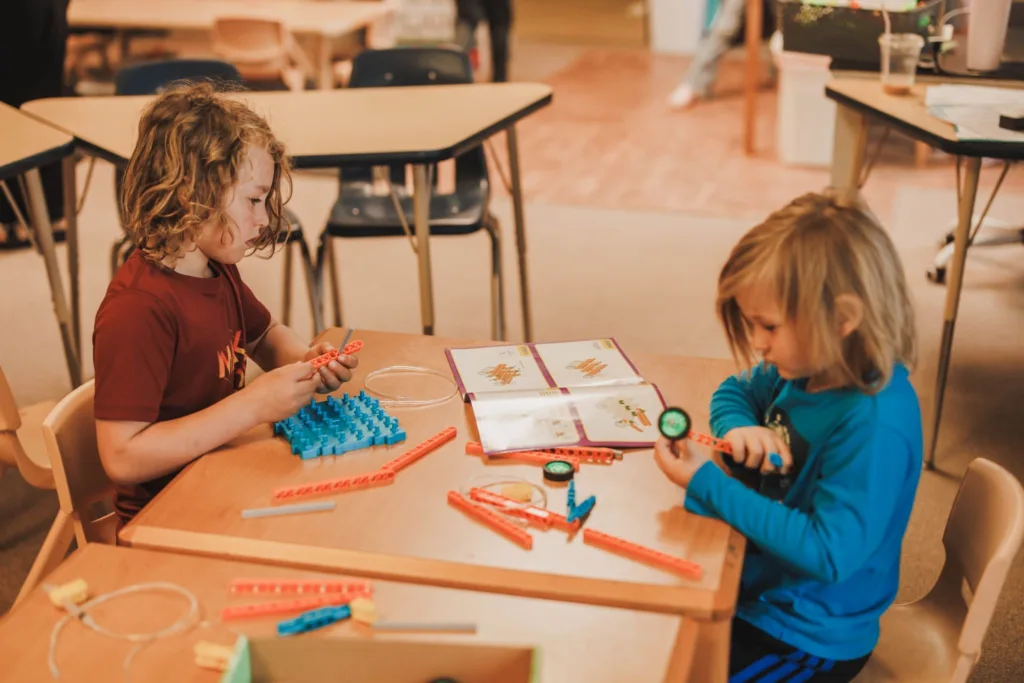
His approach centered on play, stories, songs, nature, movement, creativity, and hands-on materials. Children learned by interacting with the world around them and with one another. Froebel believed play was learning. Building with blocks meant experimenting with balance, shape, structure, and imagination. Playing with others required communication, negotiation, patience, and problem-solving. Children were not simply being prepared to sit through school. They were learning in ways that matched how children naturally develop.
Somewhere along the way, we changed that. Kindergarten gradually became more academic. Play was pushed to the edges of the day. Building became something children did after their “real work” was finished. Art became a special. Exploration became enrichment. Movement became recess. Kindergarten started looking more like first grade, then first grade started looking more like second, and the race moved downward.
MIT professor Mitchel Resnick has spent much of his career arguing that we should be moving in the opposite direction. Resnick leads the Lifelong Kindergarten group at the MIT Media Lab and developed a framework centered on four ideas: Projects, Passion, Peers, and Play. His question is simple but powerful: What if, instead of making kindergarten more like the rest of school, we made the rest of school more like kindergarten?
That idea is closely connected to what we believe at The Innovation School. Our model is also centered on Projects, Passions, Peers, and Play, not just for our youngest students, but across every grade level. The difference is the scale. A kindergartner may build a tower and discover that a wider base makes it more stable. An elementary student may design a bridge, test how much weight it can hold, and revise it. A middle school student may use that same process to research a real-world problem, design a solution, gather information, revise a prototype, and present his or her thinking to an authentic audience.
The learning grows up with the child. The philosophy does not have to disappear. Play for a five-year-old may involve imaginative building, while play for an eleven-year-old may look like robotics, coding, engineering, art, science, or entrepreneurship. Play for a middle schooler may mean testing an idea without knowing whether it will work. That is still play in the deepest sense: experimentation, creativity, risk-taking, and learning through failure.
There is also a mental health argument for protecting play. A 2026 longitudinal study following 1,426 children found that stronger pretend-play abilities in the early years were associated with fewer internalizing problems, such as anxiety and emotional difficulties, as well as fewer externalizing behavioral problems later in childhood. Play is not simply a break from learning. It helps children practice communication, emotional regulation, problem-solving, flexibility, and navigating relationships: all skills that matter long after kindergarten ends.
The same is true of projects and passions. Younger students may need significant guidance. Older students are expected to research more deeply, manage their time, collaborate, revise their work, and take greater ownership. The goal is not to keep older students doing kindergarten-level work. The goal is to keep the conditions that made kindergarten powerful while increasing the level of challenge.
There is a difference between making learning harder and making it deeper. A worksheet can contain difficult questions. A meaningful project can require students to combine reading, writing, mathematics, research, communication, creativity, persistence, and problem-solving all at once. That is the kind of complexity we want students to grow into.
It is also why we value mixed-age learning at our school. Younger students see what is possible, while older students have opportunities to mentor and lead. Students learn that people of different ages and abilities can contribute different strengths to the same community. As students grow, the expectations increase, the projects become more ambitious, the questions become bigger, and the independence grows. But we do not believe that curiosity, creativity, collaboration, movement, or play should have an expiration date.
Resnick’s idea of lifelong kindergarten is not about turning middle school into an extended recess. It is about preserving the conditions that make deep learning possible. Froebel reminds us that kindergarten was originally designed around the way children naturally learn. Resnick challenges us to consider whether we should have abandoned those principles as quickly as we did.
At The Innovation School, we are trying to do something different: not keeping students little, but letting learning grow up with them. The complexity changes. The expectations change. The independence changes. But the foundation remains: Projects. Passions. Peers. Play.